Jeff Hirsh
69
Read: August 2025
Inspiration: interested to understand more about the commodity markets
Summary
Written with the help of ChatGPT, below is a brief summary to understand what is covered in the book.
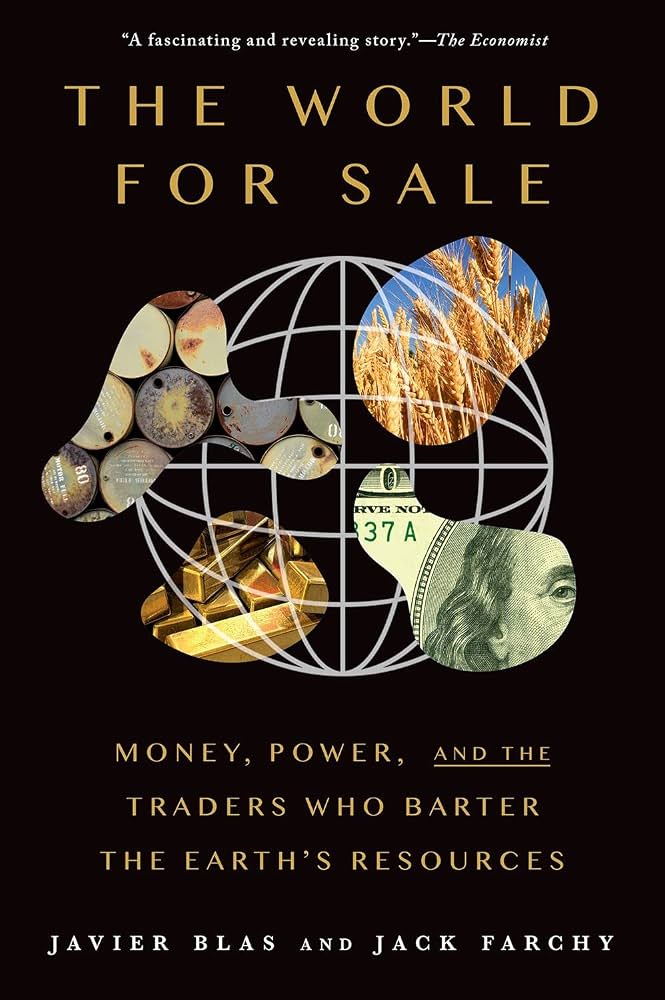
| “The World for Sale”, published in 2021 by journalists and authors Javier Blas and Jack Farchy, explores the largely hidden world of commodity traders who move the oil, metals, minerals, and agricultural products that underpin the global economy. The authors trace the rise of firms such as Glencore, Vitol, and Trafigura and show how traders built enormous businesses by financing and transporting commodities across countries, including some of the world’s most unstable political environments. Through stories involving figures such as Marc Rich and governments in Iraq, Libya, Russia, and elsewhere, the book demonstrates how commodity traders often accumulated significant geopolitical influence alongside their financial power. Blas and Farchy also examine the industry’s culture of secrecy, aggressive risk-taking, and willingness to operate in jurisdictions where corruption, sanctions, and political instability were common. Ultimately, the book reveals how a relatively small group of private companies became indispensable intermediaries between resource-producing countries and the global economy. |
Unedited Notes
Direct from my original book log, below are my unedited notes (abbreviations and misspellings included) to show how I take notes as I read.
Commodity traders are enormous but deliberately invisible middlemen connecting producers + consumers of oil/metals/grain etc, business looks simple—buy commodity somewhere and sell somewhere else—but actual edge comes from logistics, credit, information, political relationships and willingness to operate where normal companies/banks won’t, post-WWII oil industry initially dominated by Seven Sisters/major oil companies controlling production through distribution, rise of independent traders breaks system as national oil companies/OPEC create more spot-market barrels and geopolitical shocks create arbitrage, Marc Rich central figure—worked at Philipp Brothers then broke away with Pincus Green, aggressively traded oil across political boundaries including countries under embargo/sanctions, basic philosophy commodity has no ideology—it flows to buyer willing to pay, US indicted Rich in 1983 for tax evasion/trading with Iran and he fled to Switzerland, later controversially pardoned by Clinton in 2001, Marc Rich + Co eventually becomes Glencore after management buyout led by Willy Strothotte/Ivan Glasenberg, Rich alumni also seed broader Swiss trading ecosystem incl Trafigura etc, Switzerland/Geneva becomes center because finance, secrecy, taxes and proximity to shipping/trade expertise, trading economics depend on tiny margins applied to massive volumes so credit is “lifeblood”—banks provide billions in short-term financing against cargo, trader can become effectively shadow bank to governments/producers, in developing countries traders advance cash against future oil/mineral production which can give desperate governments immediate funds but lock in commodity flows/debt for years, industry thrives on disruption—wars, embargoes, government collapse, shortages make commodities mispriced and create need for someone willing to solve logistics, Libya 2011 amazing example—Vitol supplied ~$1bn fuel to rebels fighting Qaddafi and was repaid partly with crude once rebels gained control, company effectively performing geopolitical role normally associated with states, Iraq oil-for-food era traders used layers of intermediaries/offshore companies and some paid illicit surcharges to Saddam regime, Glencore/Vitol/Trafigura/Gunvor repeatedly operate in jurisdictions with corruption/weak governance and industry later faces major bribery investigations, Trafigura toxic waste scandal in Ivory Coast showed downside of hyper-aggressive culture/logistics, traders develop exceptionally valuable info because see physical flows before financial market knows—know ships, inventories, refinery outages, mine output etc, can speculate around physical knowledge, unlike hedge funds they can actually redirect cargo/store commodity/blend grades, Glencore takes model further by buying mines/production assets so both produces and trades commodities, Glasenberg pushes massive growth then 2011 IPO exposes previously secret ownership/wealth and makes employees billionaires, Chinese industrial rise is enormous tailwind—China consumes huge incremental amounts of copper/iron ore/oil etc and traders intermediate flows from Africa/Latin America to Asia, traders gain influence because many resource-rich countries have weak financial systems but commodities are hard currency, deals can shape governments—Chad, Kazakhstan, Kurdistan etc become dependent on advances/trading houses, Kurdish oil trade even helped regional government finance itself independently of Baghdad, sanctions/regulation increasingly constrain old anything-goes model and public companies face more scrutiny, but traders remain essential because someone has to manage mismatch between where/when commodity produced and where/when needed, broad takeaway is globalization not just multinational brands/banks but small group of private trading firms moving physical building blocks of world economy and accumulating enormous political power almost accidentally through financing/logistics.