Jeff Hirsh
84
Read: January 2026
Inspiration: wanted to understand more about the history of Nvidia and Jensen Huang
Summary
Written with the help of ChatGPT, below is a brief summary to understand what is covered in the book.
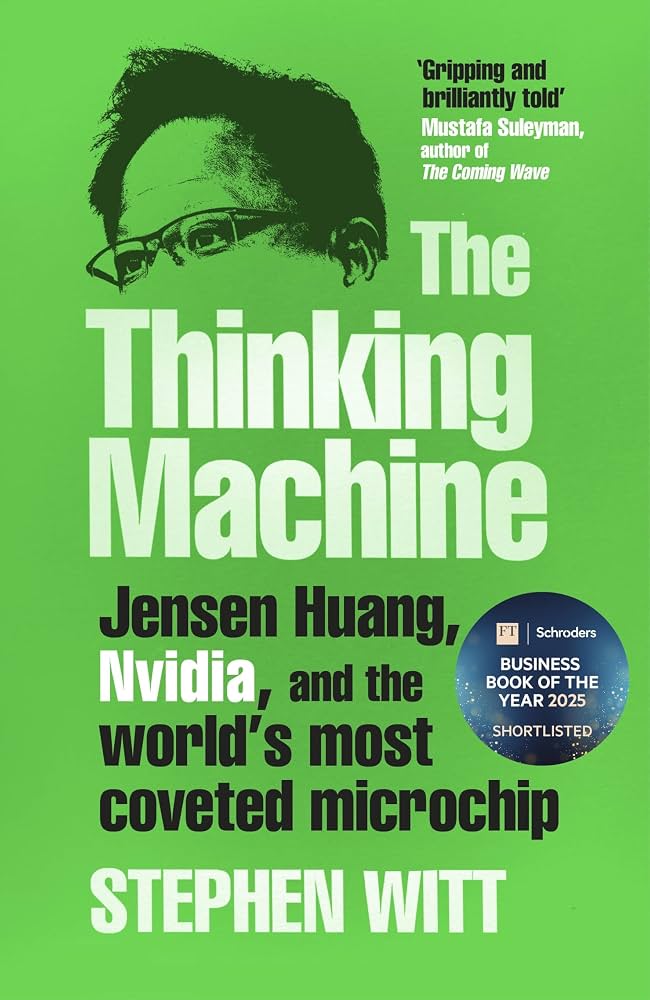
| “The Thinking Machine”, published in 2025 by journalist and author Stephen Witt, tells the story of Jensen Huang and Nvidia’s transformation from a video-game graphics company into one of the most important companies powering the artificial intelligence revolution. Witt traces Huang’s early life, Nvidia’s founding in 1993, and the repeated technical and financial challenges that shaped the company’s highly demanding culture. He explains how Nvidia’s development of graphics processors and its long-term investment in the CUDA software platform positioned its chips to become uniquely valuable for training modern neural networks. The book follows Nvidia’s rise alongside breakthroughs in deep learning and generative AI, while examining Huang’s unconventional management style and willingness to invest years ahead of obvious commercial demand. Ultimately, it shows how decades of investment in accelerated computing, software, and developer infrastructure allowed Nvidia to become a foundational supplier to the modern AI economy. |
Unedited Notes
Direct from my original book log, below are my unedited notes (abbreviations and misspellings included) to show how I take notes as I read.
Jensen Huang born Taiwan, spent part childhood Thailand before being sent to US and had rough experience at Kentucky boarding school, eventually Oregon State electrical engineering then Stanford masters, worked AMD/LSI Logic before deciding computing graphics opportunity big enough to start company, Nvidia founded 1993 with Chris Malachowsky + Curtis Priem—famously discussed idea at Denny’s, initial market was graphics/video games and company repeatedly close to death, first chips bet on wrong technical architecture and Nvidia had basically one shot left to redesign product quickly—culture forged around permanent feeling company could die, Jensen runs organization with extreme urgency/direct communication and unusually large number of direct reports, not big believer in traditional hierarchy/1:1 bureaucracy, graphics chips fundamentally different from CPUs because graphics requires doing huge number of similar calculations simultaneously, CPU optimized more for sequential/general-purpose tasks while GPU parallelism eventually turns out perfect for neural networks, Nvidia’s gaming successes incl RIVA/GeForce establish company but insight was GPU general-purpose computing platform, 2006 launch CUDA huge long-term bet—software layer lets programmers use Nvidia GPUs for non-graphics computation, initially cost a lot and had limited customers so Wall Street/question internally why bother, but CUDA builds developer ecosystem and creates moat far beyond silicon itself, important because hardware competitors can in theory make chips but replacing years of CUDA libraries/tools/developer habits much harder, 2012 AlexNet is key hinge—Alex Krizhevsky/Ilya Sutskever/Geoffrey Hinton use Nvidia GPUs to train deep neural net that crushes ImageNet competition, proof GPU acceleration could unlock deep learning, Jensen sees significance early and increasingly commits company to AI before revenue obvious, rather than just sell graphics cards Nvidia starts designing entire stack—chips, networking, systems, software, libraries, eventually giant data-center “AI factories,” transformer breakthrough + scaling laws cause compute requirements to explode which plays directly into Nvidia architecture, ChatGPT then makes years of underlying AI investment visible to world and demand for H100s/data center GPUs goes crazy, hyperscalers Microsoft/Meta/Amazon/Google spending tens of billions on AI infrastructure, Nvidia becomes bottleneck because frontier AI labs need enormous clusters of its chips, manufacturing interesting—Nvidia is fabless, designs chips but TSMC manufactures them so value chain depends heavily Taiwan and advanced packaging/memory suppliers, Nvidia survived chip wars where huge number competitors disappeared because speed/software/developer ecosystem compounded, important lesson that overnight success was ~30 years of infrastructure built before demand arrived, Nvidia’s advantage not simply one magical microchip but vertically integrated platform + CUDA network effects + pace of iteration, transition from niche gaming hardware to picks-and-shovels provider for AI boom, Jensen believes accelerated computing replaces traditional CPU-centric model and AI is beginning of new industrial revolution rather than temporary product cycle