Jeff Hirsh
75
Read: April 2026
Inspiration: heard the book discussed on a podcast and interested to learn more on economic warfare
Summary
Written with the help of ChatGPT, below is a brief summary to understand what is covered in the book.
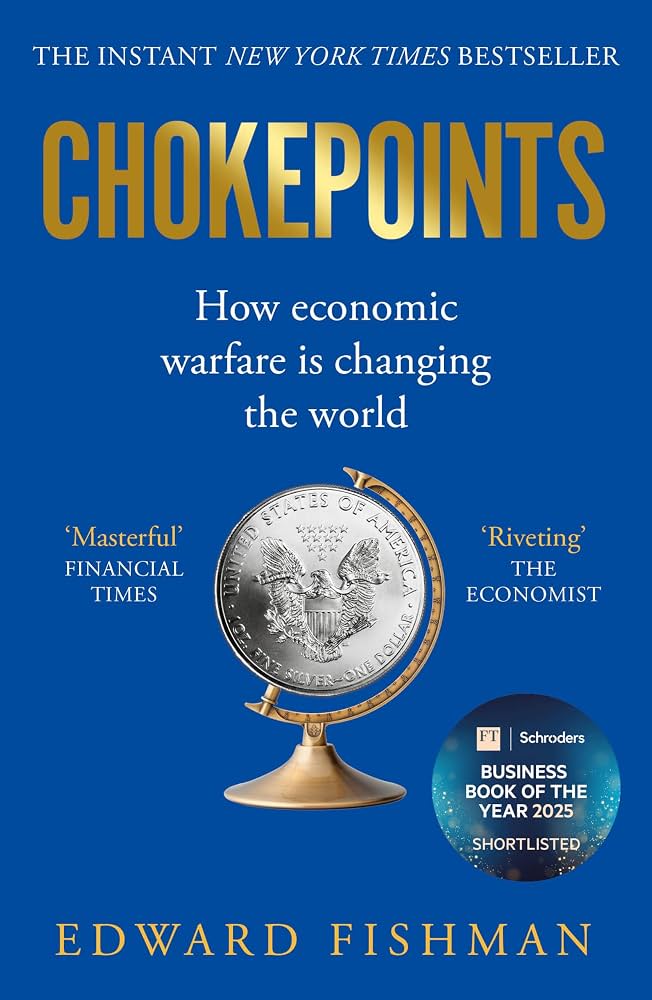
| “Chokepoints”, published in 2025 by professor and author Edward Fishman, examines how the United States has increasingly used its central position in global finance, technology, and trade as a tool of geopolitical power. Fishman traces the evolution of modern economic warfare through sanctions against Iran and Russia, restrictions on advanced technology exports to China, and efforts to control access to critical financial and technological infrastructure. He explains how the dominance of the U.S. dollar, American financial institutions, and allied control of key semiconductor technologies create economic chokepoints that governments can use to pressure adversaries. At the same time, the book explores the limitations and unintended consequences of these tools, including incentives for targeted countries to develop alternative financial and technological systems. Ultimately, Fishman argues that economic networks have become a central battlefield of modern geopolitics and that the durability of American leverage will depend on how carefully that power is used. |
Unedited Notes
Direct from my original book log, below are my unedited notes (abbreviations and misspellings included) to show how I take notes as I read.
Modern economic warfare increasingly about controlling networks/chokepoints vs old model of ships/blockades—US sits at center of several indispensable global systems, especially dollar/financial system, advanced semiconductors/technology, and allied-controlled infrastructure, which gives US ability to hurt another economy without firing weapons, globalization ironically created these weapons because world became more interconnected around a handful of nodes, post-9/11 US began realizing access to dollar clearing/US banks was a huge source of leverage—if Treasury designates entity, banks globally often cut it off because losing access to US financial system is existential, Iran became major proving ground—US moved from targeting specific bad actors to progressively restricting banks/oil and threatening third-country institutions doing business with Iran, sanctions effective partly because US acted with Europe/allies and because Iran depended on oil revenue/global banking, economic pressure helped create leverage around 2015 nuclear agreement though exact role/causality debated, Trump later withdrew from deal and reinstated “maximum pressure,” showing sanctions can create pain without automatically producing desired political outcome, Russia/Crimea in 2014 another key experiment—Obama admin deliberately calibrated sanctions because fear of destabilizing global markets/Europe, targeted banks/energy financing/individuals rather than full economic cutoff, Fishman argues officials were often extremely cautious about using full US leverage, 2022 Ukraine invasion then produced much larger coordinated package—freeze Russian central bank reserves, remove selected banks from SWIFT, export controls, energy measures etc, but Russia’s continued commodity exports show limits when target controls something rest of world needs, important difference b/w financial chokepoint and physical commodity where alternative buyers/routes exist, China challenge shifts battlefield from dollar toward technology, advanced chips require extraordinarily concentrated supply chain—US chip design/software, Nvidia/AMD, Dutch ASML lithography, Taiwan/Korea manufacturing etc, export controls can therefore deny China frontier computing capabilities even without broad trade embargo, Oct 2022 semiconductor controls major step because designed not merely around specific Chinese companies but ability to develop advanced AI/supercomputing, foreign-direct-product style rules extend US jurisdiction through American technology embedded in overseas production, chokepoint power strongest when 1) network is highly concentrated, 2) US/allies control indispensable node, 3) target cannot quickly substitute, but every use creates incentive to route around chokepoint—China/Russia/Iran build alternate payment systems, local currency trade, domestic chips etc, overuse can therefore erode leverage over time, sanctions also have humanitarian/spillover costs and enforcement constantly becomes cat-and-mouse game through shell companies/transshipment, private companies/banks become frontline implementers of foreign policy even though not elected policymakers, tension is US spent decades building open/globalized system then increasingly weaponized access to it, core strategic question is how aggressively to use unique leverage today without accelerating creation of a world where leverage disappears tomorrow.