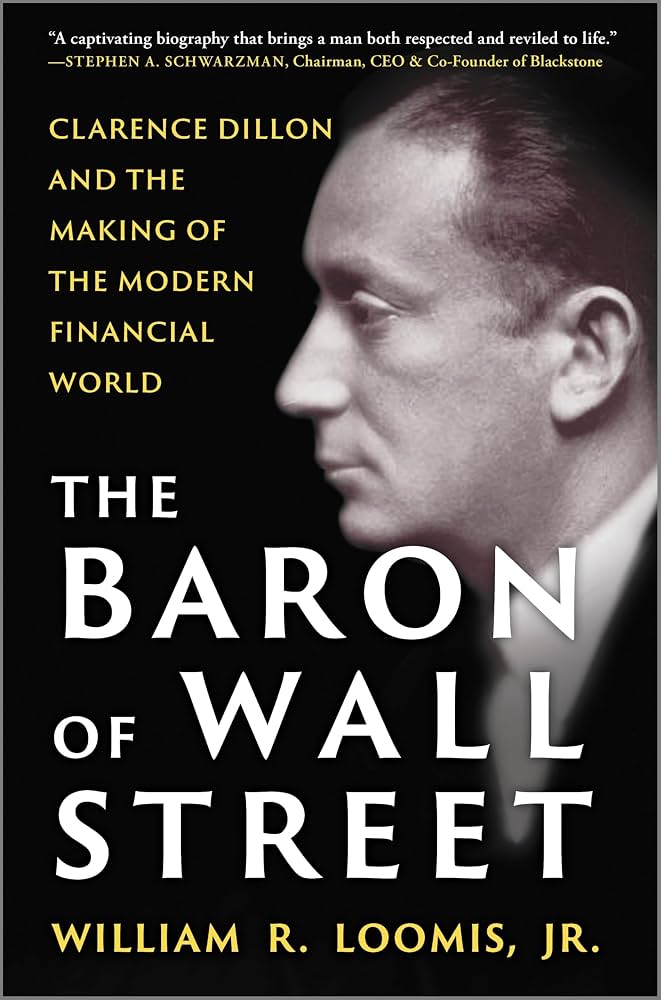
Jeff Hirsh
63
Read: November 2025
Inspiration: found the book in airport bookstore and was intrigued
Summary
Written with the help of ChatGPT, below is a brief summary to understand what is covered in the book.
| “The Baron of Wall Street”, published in 2025 by former banker and author William R. Loomis Jr., chronicles the life and career of financier Clarence Dillon and his role in transforming American investment banking during the early twentieth century. Loomis follows Dillon’s rise from a relatively obscure background to leadership of Dillon Read, where he became one of Wall Street’s most influential dealmakers during the 1920s. The book examines major transactions involving companies such as Goodyear and Dodge Brothers while describing Dillon’s pioneering use of restructuring, leveraged acquisitions, and innovative securities financing. It also explores his relationships across business, politics, and society and the growing influence of Wall Street on American economic and foreign policy. Ultimately, the book presents Dillon as an overlooked figure whose financial innovations helped bridge the era of traditional merchant banking and the transaction-driven world of modern Wall Street. |
Unedited Notes
Direct from my original book log, below are my unedited notes (abbreviations and misspellings included) to show how I take notes as I read.
Clarence Dillon born 1882 in Texas, family name originally Lapowski before father changed it to Dillon, came from comfortable merchant family but not established East Coast elite, sent east to Worcester Academy then Harvard and basically spends career consciously entering upper tier of American finance/society, starts Wall Street at brokerage/banking firm William A. Read & Co and rises extraordinarily fast—by 1921 name changed to Dillon Read, reportedly because Dillon argued he generated majority of business, key theme is transition of Wall Street from old relationship banking dominated by houses like Morgan into more aggressive deal-making/financial engineering, Dillon less constrained by traditional norms and willing to use securities structures/control transactions in novel ways, Goodyear early landmark—company financially distressed after WWI expansion and Dillon Read restructures it, creditors gain control/new management installed and founder Frank Seiberling pushed out, template looks surprisingly modern PE/distressed investing: provide financing, take control, change management/capital structure and recover value, Dodge Brothers even bigger—founders had died and heirs wanted out, Dillon assembled syndicate and in 1925 bought company for $146mm, one of largest cash transactions ever at time, then refinanced business/sold securities to public while maintaining control, effectively early leveraged-buyout style transaction decades before term existed, 1928 negotiates sale/combination with Walter Chrysler in marathon meetings at Ritz-Carlton—Dodge valued around $170mm and deal helps Chrysler jump into top tier of auto industry, Dillon reportedly earned enormous profit for firm/syndicate, broader innovation was willingness to finance acquisitions with layers of debt/securities that resemble later LBO/high-yield markets, book credits him as pioneer of techniques that eventually evolve into junk bonds and modern restructuring/bankruptcy practice though terminology came much later, Dillon Read also huge underwriter of corporate/foreign debt during 1920s, US capital floods into post-WWI Europe/Germany and Wall Street becomes increasingly tied to international political order, foreign bond boom demonstrates danger when bankers earn underwriting fees upfront but ultimate investors bear sovereign/credit risk, Depression exposes excesses of 1920s finance and creates backlash/regulatory scrutiny, Dillon cultivated extraordinary network across business/politics/social world—Edison, Chaplin, Joseph Kennedy, FDR-era figures etc—wealth opens doors but he also deliberately builds legitimacy through art/philanthropy/social institutions, personality portrayed as polished/elegant but ruthless in deals and control battles, not beloved relationship banker as much as relentless financial tactician, interesting family legacy—son C. Douglas Dillon later runs Dillon Read, serves as ambassador and Treasury Secretary under JFK/LBJ, so family moves from Wall Street wealth into core of US government/foreign policy, Clarence’s story useful because financial structures thought of as 1980s inventions—LBOs, distressed restructurings, lower-quality debt, banker-driven mergers—had prototypes in 1920s, also demonstrates recurring tension of modern finance: banker can create enormous value/liquidity and rescue failing companies while simultaneously profiting through complexity/asymmetric information/control, by late 1920s Dillon among richest/most influential financiers in US despite name far less remembered than Morgan/Rockefeller, essentially bridge between old merchant-bank Wall Street and modern transaction-driven investment banking.