Jeff Hirsh
 Read: March 2025
Inspiration: Heard a podcast on the telegraph and was curious to learn more about its origins
Summary
Written with the help of ChatGPT, below is a brief summary to understand what is covered in the book.
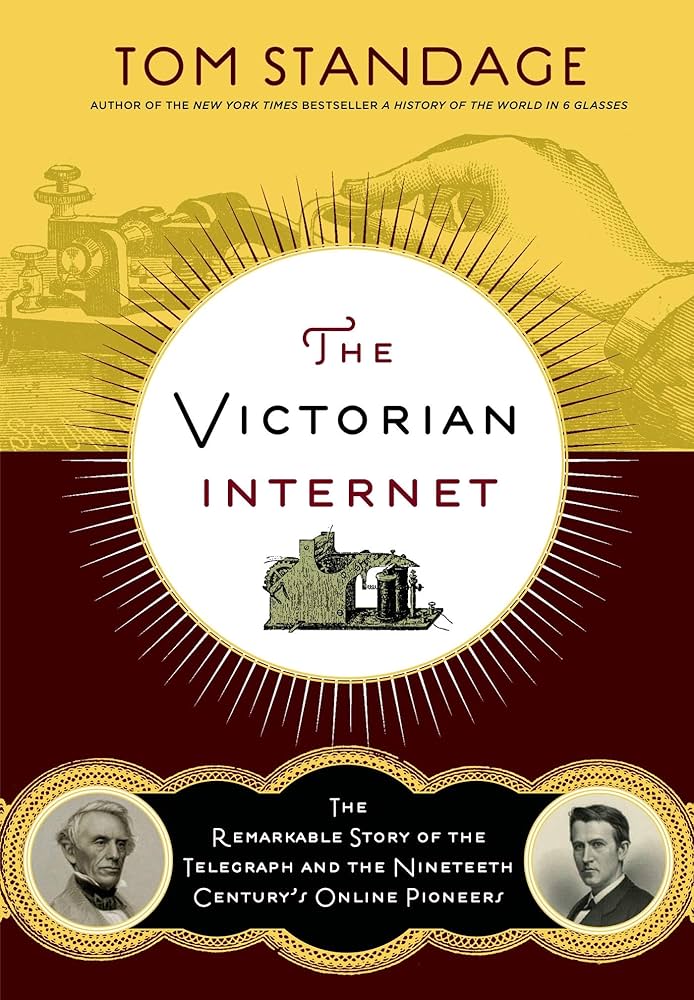
“The Victorian Internet”, published in 1998 journalist and author Tom Standage, tells the history of the electric telegraph and how it became the nineteenth century’s first global communications network, reshaping society much like the modern Internet. Standage traces the invention and spread of the telegraph, highlighting the visionaries and early pioneers who built and expanded the system across continents and under oceans. He draws clear parallels between the telegraph’s cultural and social effects—such as new business practices, rapid news transmission, romance and even crime over the wires—and the Internet’s impact centuries later. The book also explores the challenges, skepticism, and hype that surrounded the telegraph in its early years, showing how people struggled to adapt to instantaneous communication. Ultimately, Standage argues that the telegraph’s revolution in communication was a transformative moment in history, collapsing time and space in ways surprisingly similar to the digital age.
Unedited Notes
Direct from my original book log, below are my unedited notes (abbreviations and misspellings included) to show how I take notes as I read.
Claude Chappe in france was a researcher trying to harness electricity to send messages from place to place, started by using loud clangs striking a casserole dish that could be heard .25 miles away and each person had synchronized clocks so could clang at specific clock interval, had numbered dictionary to translate nums to words, 1791 replace audible clang with visual panels atop towers and use telescopes manned by people at each tower to watch panels pivot colors as also watch synchronized clocks to indicate number/letters, transmitted a msg between castles 10 miles away in 4 minutes, Chappe wanted to call it “tachygraphe” (fast writer) but friend suggest telegraphe (greek for far writer), Chappe gain support amongst french gvt to build more towers and also 1792 pivot from clock to tall rotating bar with arms atop tower—arm positions rotate for diff letters (operator inside controlled), had codebook with 92 numbered meanings—8464 words/phrases possible via 2 arms to transmit 2 codes in succession, Chappe/Style Optical Telegraph get big funding for new lines across France, Paris-Lille line was first arm of French State Telegraph operational May 1794, Napoleon seized power 1799 and big proponent—wanted to expand to signal across english channel and to Milan, etc, Britain follow with telegraph designed by George Murray but use shutter telegraph so many more combos of signals, Claude Chappe was paranoid and faced rivals trying to take fame and killed himself 1805, by mid 1830s—telegraph lines sprang across europe, big innovation hurdle was using electricity so no longer optical relaying of msgs, so many tried and failed that seemed impossible by 1830s, Francis Ronalds had a working prototype in england 1816 but overlooked as gvt say with war ending telegraph system improvements not needed, optical telegraphs very expensive and not work in the dark so electric telegraph was the solve, Samuel Morse was from Massachussetts, a successful painter of portraits of wealthy then of Louvre Gallery but always tinkered with inventions and 1820s interest in electromagnetism as just was new discovery and clicking as currents arrive, soon had idea for “bi signal” scheme of short and long bursts of current that would become dots/dashes as Morse Code, developed this on way back from europe/Louvre work to US, and pivoted to telegraph upon return, 1820 danish physicist Oersted observer electromagnetism—current flowing in wire gives rise to magnetic field and detect field via effects on another object (eg compass needle moves), galvanometer detects current flow via rotating needle, Morse needed cash to scale—Congress gave $30k in 1843 for line from DC to Baltimore, Alfred Vail was the unsung hero who worked w/ Morse—Vail likely the one who actually refined “Morse Code” to make code efficient, May 1844 first official msg “What Hath God Wrought” sent—telegraph took off, meanwhile in UK Cooke & Wheatstone had “needle telegraph” (didn’t use code, used needles to point at letters)—popularized after 1845 when used to catch a murderer (John Tawell) who tried to flee on a train—telegraph msg reached station before he did, first time people realized info moves faster than humans, 1850s was “telegraphic boom”—lines across every continent, but the “Big One” was the Atlantic—Cyrus Field was the visionary/obsessive who wanted to link US and UK, 1858 first cable laid but failed after a few weeks bc of high voltage frying the insulation, 1866 finally succeeded using the “Great Eastern” (massive ship)—changed everything, news went from 10 days by ship to minutes, “Annihilation of Space and Time” was the buzzphrase, social life changed—operators became the first “internauts,” spent all day on the wire, developed “slang” and shorthand to save time, operator romances were huge—marriages performed over the wire, hacking/security became a problem—businessmen used “ciphers” (codes) to hide secrets, gvts tried to ban ciphers bc they couldn’t spy on msgs, birth of “Information Overload”—newspapers getting too much news too fast, people complained about the “stress” of being constantly reachable (first time in history), stock market “ticks” changed finance—no more waiting weeks for prices, led to first “flash crashes” and scams where people intercepted scores of horse races to bet, pneumatic tubes used in big cities (London/Paris/NY) to move physical slips of paper even faster btwn offices, eventually the “Telephone” (1876) killed the telegraph—Bell’s invention was easier (no need to learn code), Western Union turned down buying Bell’s patent for $100k—biggest mistake in biz history, Standage concludes that the 19th c. “Victorian Internet” was the bigger revolution—moving from “speed of horse” to “speed of light” is a bigger leap than “slow computer” to “fast computer,” we aren’t living in a new age, just an accelerated one