Jeff Hirsh
 Read: May 2025
Inspiration: Heard the authors on a podcast and wanted to read the full story
Summary
Written with the help of ChatGPT, below is a brief summary to understand what is covered in the book.
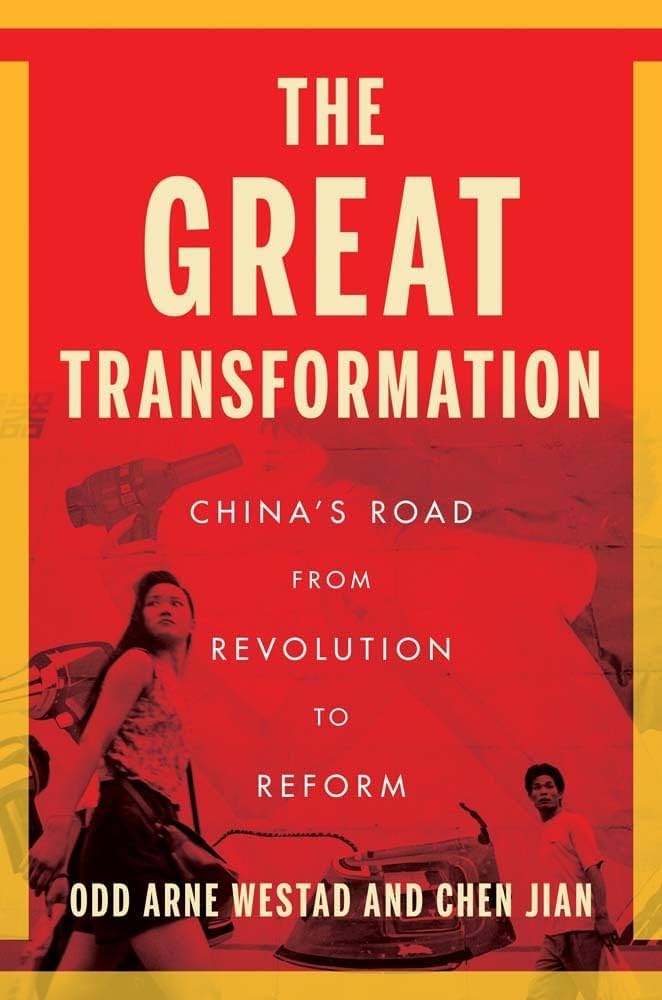
“The Great Transformation”, published in 2024 by professors and authors Odd Arne Westad and Chen Jian, offers a comprehensive history of how China moved from the turmoil of the Cultural Revolution to become a reform-era power in the late twentieth century. The authors focus on the “long 1970s,” showing that this period of political upheaval, leadership struggles, and grassroots initiatives set the stage for China’s dramatic economic and social changes. They argue that China’s opening to the world and gradual embrace of market mechanisms was not inevitable but shaped by contingent historical forces and a mix of internal pressures and global influences. The narrative highlights how ordinary people and local entrepreneurs played significant roles in driving reform alongside elite political figures. Ultimately, Westad and Chen portray China’s transformation as a complex, non-linear process that reshaped the country’s domestic order and its place in the world.
Unedited Notes
Direct from my original book log, below are my unedited notes (abbreviations and misspellings included) to show how I take notes as I read.
Title nod to Karl Polanyi’s 1944 classic re: market society being socially/politically constructed—not a natural occurrence, argue China’s shift from Maoist command to market economy wasn’t just 1978 Deng “miracle” but longer/messier process starting early 70s, seeds planted under Mao/Zhou Enlai bc Maoist system failing even before he died, Zhou Enlai’s 1975 speech on “Four Modernizations” (agri, industry, nat defense, sci/tech) really the secret roadmap even while Mao still alive—Mao knew economy was failing but couldn’t admit it, huge tension btwn “Red” (ideology) and “Expert” (pragmatism), key turning pt 1971 Lin Biao incident (Mao’s successor dies in plane crash after failed coup)—shattered faith of general pop in CCP ideology/infallibility, people realize the “Emperor” is lost, 1972 Nixon visit not just geopolitics vs USSR but start of massive tech/economic opening, China desperate for Western tech to modernize military and infra, “Great Leap Outward” (term for Hua Guofeng era) = buying whole factories/turnkey plants from Japan/West/Europe, Hua Guofeng often ignored in history but Westad/Chen show he was bridge btwn Mao and Deng—pushed for SEZs (Special Economic Zones) and foreign trade before Deng took full control, reform was “bottom-up” as much as “top-down”—starving peasants in Anhui and elsewhere started secret “household responsibility” farming (splitting land) bc state communes didn’t work, local officials looked other way bc needed to eat, Beijing eventually just legalized what was already happening on ground, influence of East Asian “Tigers” (Japan, HK, Taiwan, Singapore) was huge—Communist leaders saw neighbors getting rich and realized China falling behind in “race for survival,” 1978 Plenum was more about legitimizing local experiments than a specific blueprint, Deng’s “feeling the stones to cross the river” = no master plan, just trial and error, Deng purged twice but kept coming back bc he was the only one who knew how to actually manage the party/economy bureaucracy, 1978-1979 was the “Great Pivot”—Deng visit to Tokyo and US (1979)—first time a CCP leader really saw the West, he was fascinated by Boeing plants and NASA, realized China was 50 yrs behind not 10, “Overseas Chinese” (diaspora) in HK/Singapore/SE Asia were the secret weapon—provided 80% of initial foreign investment bc they shared culture/language when Westerners were still too scared to invest, 1979 “normalization” of relations w/ US—Coca-Cola enters China same month as normalization—symbolic end of Maoist isolation, Hua Guofeng’s “Two Whatevers” (follow whatever Mao said) vs Deng’s “Seek Truth From Facts” (if it works, it’s good)—Deng won the ideological battle by making pragmatism the new religion, “Democracy Wall” 1978-79—brief window of free speech in Beijing, Wei Jingsheng’s “Fifth Modernization” (argued you can’t have econ reform without democracy)—Deng supported the wall at first to weaken his rivals (the Maoists) but then crushed it and jailed Wei once he had full power, shows Reform was always meant to save the Party not replace it, 1980 Shenzhen starts as tiny fishing village—became the “lab” for capitalism, Westad emphasizes China’s transformation happened with the world not just inside China, was a “Self-Transformation” via learning from the enemies (US/Japan), authors argue “reform and opening” was a global event—happening at same time as Thatcher/Reagan/neoliberal shift, China’s transformation essential to end of Cold War bc it pulled China into global capitalist system vs Soviet bloc, downside was “market authoritarianism”—econ freedom without political pluralism, “The Great Transformation” isn’t just a change in policy but a change in how a billion people viewed their place in the world—shifting from permanent revolution to permanent growth, the book warns that the “1970s deal” (econ growth for political loyalty) is the same one the CCP is trying to maintain today but now under much higher pressure.